← Back to Case Files
Case #00000172
open
Evidence on file
Sailing Stones of Death Valley — Rocks Move Across Desert Floor Without Human or Animal Assistance
Unverified report — this account has not been independently confirmed. Treat all claims as witness testimony pending investigation.
Witness Account
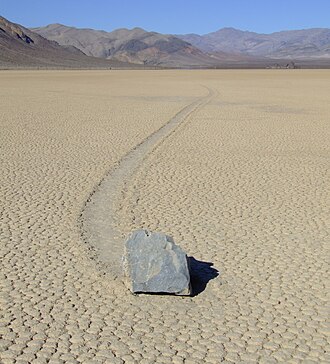
On the flat, dry lakebed of Racetrack Playa in Death Valley National Park, rocks weighing hundreds of pounds leave long, meandering tracks across the cracked mud as though they have moved on their own. No person or animal has ever been witnessed causing the movement, and the rocks travel paths that suggest sustained locomotion — turning, stopping, reversing direction, and in some cases traveling parallel to other rocks.
The phenomenon has been documented and photographed since the early 20th century. Rocks the size of boulders travel hundreds of meters, sometimes with tracks running parallel to each other suggesting simultaneous movement. The dried mud around the tracks shows no evidence of animal tracks or human interference. Some rocks appear to collide, leaving distinctive impact marks.
For nearly a century the cause was unknown and the sailing stones attracted paranormal and pseudoscientific speculation ranging from magnetic forces to aliens. In 2014, a team of researchers from UC San Diego led by Richard Norris finally captured the movement on time-lapse cameras and GPS sensors.
The explanation proved mundane: during rare winter rains, a shallow pond forms on the playa. When temperatures drop below freezing, the water forms thin sheets of ice up to 3-5mm thick around the rocks. When the ice begins to melt and break up in daytime sunshine, large sheets pushed by gentle winds can slide the rocks across the lubricated mud surface. The phenomenon requires an exact set of conditions and was never captured before because observation was so rare.
The phenomenon has been documented and photographed since the early 20th century. Rocks the size of boulders travel hundreds of meters, sometimes with tracks running parallel to each other suggesting simultaneous movement. The dried mud around the tracks shows no evidence of animal tracks or human interference. Some rocks appear to collide, leaving distinctive impact marks.
For nearly a century the cause was unknown and the sailing stones attracted paranormal and pseudoscientific speculation ranging from magnetic forces to aliens. In 2014, a team of researchers from UC San Diego led by Richard Norris finally captured the movement on time-lapse cameras and GPS sensors.
The explanation proved mundane: during rare winter rains, a shallow pond forms on the playa. When temperatures drop below freezing, the water forms thin sheets of ice up to 3-5mm thick around the rocks. When the ice begins to melt and break up in daytime sunshine, large sheets pushed by gentle winds can slide the rocks across the lubricated mud surface. The phenomenon requires an exact set of conditions and was never captured before because observation was so rare.
Community Assessment
Investigator Notes (0)
Create an account or sign in to add investigator notes.
No investigator notes yet — be the first to file one.